Green roofs or vegetative covers are increasingly becoming widespread as an energy-saving option that also contributes to the healthiness of our cities’ atmospheres. What exactly are they? How do they work? How are they installed? In this article, we will review the advantages and disadvantages of this architectural trend.
Definition of Green Roofs
As we have already said, green roofs are a trend. Building designs with vegetative covers are spreading in our urban centers. Contrary to what it might seem, it is not about placing plants in individual containers, but about a permanent installation that is part of the building and allows covering the entire extension of a building’s roof with plant elements.
Types of Green Roofs
Depending on their complexity, the type of vegetation, and their accessibility, there are different types of green roofs. We can divide them into the following classification:
- Extensive: characterized by a lightweight thickness. Their total weight is low, and the visual effect is that of a meadow with grass. They do not support much weight, therefore their accessibility is limited.
- Semi-intensive: in this case, the type of vegetation is more complex and requires more maintenance. It is more ornamental than the previous one, and the soil layer has greater weight. It is a space that can be walked on by people.
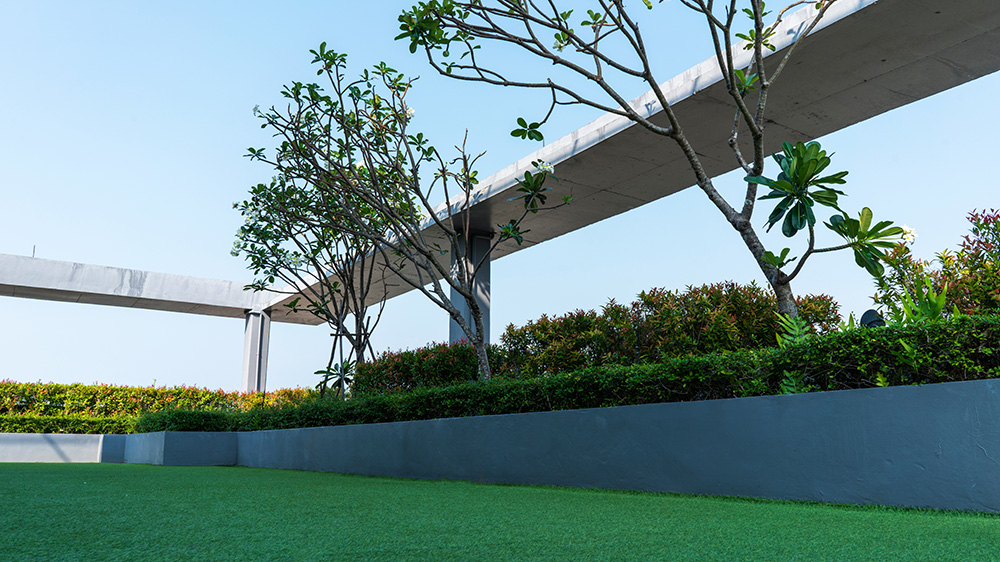
- Intensive: this type of green roof includes heavier plant species such as shrubs or trees. This means that the structure must be prepared to support a lot of weight, including the transit of people enjoying the space as if it were a park.
Advantages of Green Roofs
Green roofs are more than just a good energy-saving system. Urban centers concentrate more and more population, more traffic, and therefore more energy consumption that produces substances harmful to health. The construction of buildings and streets made of asphalt is inevitable to concentrate so many people in a reduced space. However, it is essential to maintain green spaces that help cool the environment and renew the air. Green roofs are a viable option that can help improve the quality of life in cities.
There are two types of advantages regarding green roofs: general ones and specific ones that affect the building. Let’s start with the general ones:
- Air purification: as we have already pointed out, they have a direct effect on reducing air pollution.
- Increase in biodiversity: they allow for the inclusion of different plant species and can also be the perfect home for insects, birds, and other species that otherwise would not have a place in the city.
The advantages related to the building are multiple, below we list some of them:
- Regulate the building’s temperature: they absorb heat and act as insulators. Therefore, they prevent sudden temperature changes. They also have a protective effect on roofs and walls.
- Save energy: thanks to their insulating power, they produce savings in heating and air conditioning.
- Improve quality of life: green spaces have a positive effect on people’s mental health. When it is a walkable space, it is clearly a relaxation space that the building’s residents can enjoy. We must not forget that they also add aesthetic value to the building. In some cases, it can even be used as a garden or for other activities.
- Insulate from noise: the insulating effect is not only for temperature. They also help reduce typical city noises.
- Prevent fire from spreading in case of fire: this is due to the humidity caused by the vegetation itself.
- Long lifespan: compared to conventional roofs, they have a much longer useful life. Conventional materials are exposed to heat, cold, rain, etc., so they deteriorate much sooner. For this to be the case, the installation must be adequate from the start.
Disadvantages of Green Roofs
Not everything could be good; the truth is that this type of roof also has some disadvantages. The main one is its installation cost. Both in execution and maintenance, it requires greater cost planning. In contrast, we can argue that its useful life is much longer as long as proper waterproofing and good execution of the joints have been carried out. Furthermore, we must not forget that it will represent long-term energy savings.
Unfortunately, not all buildings can have this type of structure, as it means extra weight added to the structure. That is why there are many buildings where this type of installation could not be done.
Poor installation can cause water leaks and dampness. Therefore, it is essential to surround yourself with good architects when making structural modifications to a building.
The importance of surrounding yourself with good architects: Arquifach
Building a home is a process whose success depends on many factors. The best way to ensure it is to count on architects who offer guarantees. A guarantee that is based on experience. It is important to choose an architecture studio that guides you throughout the process from the initial design to the delivery of the final documentation to inhabit the house, that has experience in the area and qualified personnel to carry out the comprehensive management of the project, but above all that designs according to your needs and expectations.