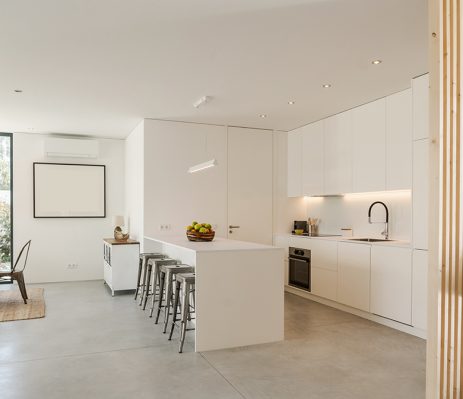
Minimalist architecture is a trend based on minimalism, whose purpose lies in the reduction of everything dispensable, leaving only the essential. Its goal is to achieve simplicity in things, to achieve a harmonious space through beauty and simplicity.
What does minimalist architecture consist of?
The main idea of this concept is not to overload spaces with unnecessary elements. On the other hand, color plays a very important role, since without a large number of elements, it takes on great prominence. This is why neutral colors are usually chosen, often combined with others, playing extensively with shapes and straight lines. The materials used must be carefully considered. For example, rustic elements are trendy as they combine very well with materials like granite, wood, or marble.
Origin of Minimalism
Minimalism is a concept born in 1930 by the German architect Ludwig Mies Van Der Rohe, who argued that architecture had to be based on simplicity, on the concept of “less is more.” It was not until the 1980s that this concept began to succeed due to the way of communicating through linear elements and simple structures. It had such an influence on the art world that it eventually made its way into architecture.
Characteristics of Minimalist Architecture
- Linear Geometry: For the most part, structures are usually based on straight lines.
- Prominence of Decoration: Lacking the dispensable, decoration occupies a very significant place in terms of design.
- Open Spaces: Good distribution of spaces is essential in minimalism, providing a sense of spaciousness and calm.
- Simple Details: Lighting, as well as white elements, take on great prominence in open spaces.
At Arquifach we work according to the client’s needs, adapting to market trends. Do not hesitate to contact us to resolve any questions.