Ventilation is the air renewal system that allows the evacuation of heat retained in the construction elements of a building. Ventilation in architecture is essential to guarantee the healthiness of buildings and prevent rooms from overheating, thus maintaining thermal comfort for habitability. All buildings have thermal insulation to maintain temperature and prevent outside air from filtering inside. However, we need ventilation systems that guarantee air renewal within the building. In this article, we will review the most optimal ventilation systems for architecture.
The ventilation system, which is often presented as a design element and is crucial for the energy efficiency of buildings, indoor air quality, health, comfort, and safety, has come to occupy a central place in the design of modern homes. In architecture, planning proper ventilation is a fundamental aspect when designing and constructing any building. Ventilation is the process of air exchange within a building. Without it, we risk overheating and discomfort, which can lead to poor indoor air quality. Therefore, the three most important aspects of ventilation are temperature control, improving comfort, and increasing energy efficiency.
The goal of ventilation is to allow warm, humid air to be expelled from a building while preventing cold, dry air from entering. In construction, this is called ventilation with negative pressure, while in the home it is known as positive pressure (i.e., when a fan extracts air from a room). In some plants, vents are used for water drainage.
Ventilation Systems in Architecture
For the necessary renewal we discussed, two types of systems can be used: mechanical or natural. The main differences are:
Mechanical Ventilation System
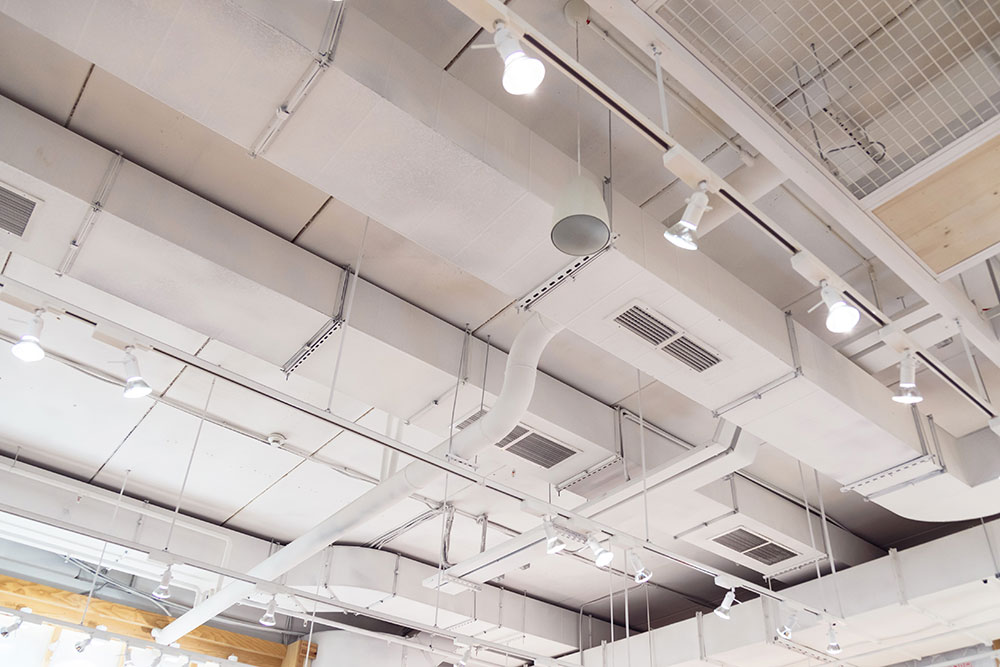
Air renewal is done mechanically, that is, through the action of fans that admit outside air through grilles. These fans generally operate using electricity. Within this classification, there are also different types that are more or less efficient:
1. Mechanical supply ventilation
Air intake (supply) occurs mechanically through the use of a fan, and air distribution is generally done through ducts. Air extraction is done by natural ventilation through infiltrations or grilles.
2. Controlled mechanical ventilation
Air extraction is done by a fan that, through a network of ducts, extracts air from humid areas (bathrooms and kitchen) and expels it outside. Supply air enters the building naturally through dry areas (bedrooms and living room) via grilles. The fan renews the air and thus guarantees indoor air quality. This makes it possible to efficiently manage energy consumption when renewing the indoor air of a space.
Within this classification, there are two types:
- Single-flow ventilation system: the renewed air comes directly from the outside. This can cause a temperature imbalance in the room.
- Double-flow ventilation system with heat recovery: this is a more complex system, as part of the energy from the extracted air is recovered. This system works by extracting stale air with fresh air like the previous one. However, the essential feature is that it allows fresh air to enter at a temperature close to the indoor temperature, which saves energy in any season.
3. Natural ventilation
Natural ventilation is the exchange of air between the air inside a building and the outdoor environment. Introducing natural ventilation will improve thermal insulation, indoor air quality, and light conditions in rooms. The combination of radiant heat produced by the sun and its reflection on snow increases the temperature in areas without insulation. Thus, during winter, the air in uninsulated places can become extremely cold. Faced with a thermal problem caused by cold air, insulating cladding that retains heat must be used. There are different types:
Simple natural ventilation
It is achieved through a single opening through which air enters and exits. Its operation is efficient if the orientation of the opening coincides with the wind direction, and if it is in contact with an area protected from insolation.
Cross natural ventilation
It occurs through openings on opposite facades, with no obstacles between them. It achieves a higher number of air changes per hour than simple ventilation. If not controlled, it can be uncomfortable.
Night natural ventilation
It takes advantage of the drop in temperature during the night to evacuate the heat accumulated during the day. It is the suitable complement, in climate zones with large temperature differences between day and night, to the use of the thermal inertia of the building’s thermal envelope.
The stack effect
The stack effect works due to temperature differences created at different heights, taking advantage of the air draft inside buildings.
The importance of surrounding yourself with good architects: Arquifach
Building a home is a process whose success depends on many factors. The best way to ensure it is to count on architects who offer guarantees. A guarantee that is based on experience. It is important to choose an architecture studio that guides you throughout the process from the initial design to the delivery of the final documentation to inhabit the house, that has experience in the area and qualified personnel to carry out the comprehensive management of the project, but above all that designs according to your needs and expectations.