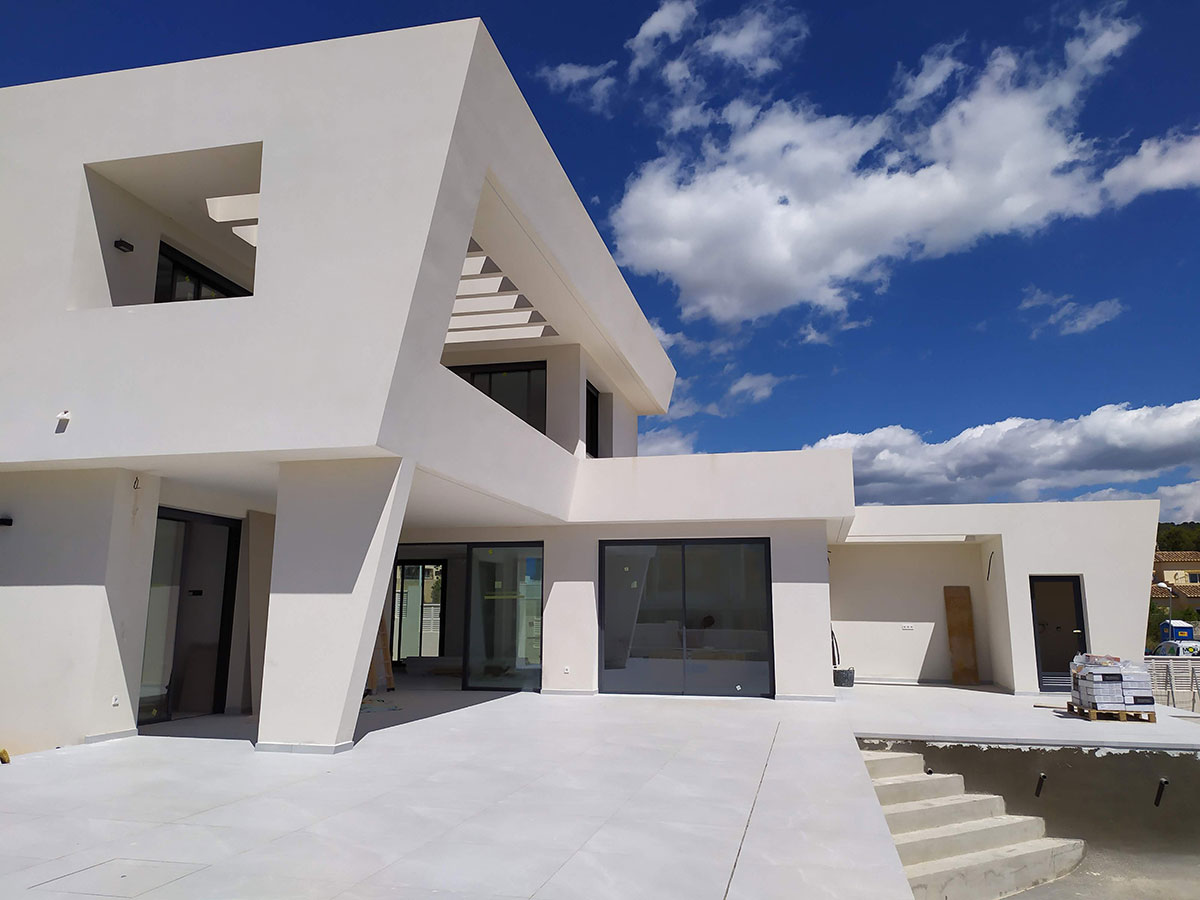
21st-century architecture is ceasing to be a static exercise and becoming a dynamic, sensitive system. As cities grow and climate change demands more efficient responses, architects and engineers are seeking materials that not only fulfill a structural function but also actively respond to the environment, learn, adapt, and even repair themselves.
Thus emerges a new generation of materials: smart materials.
These innovative composites — such as self-healing concrete, phase-change glass, and biotechnological panels — mark the beginning of an architecture that ceases to be inert and becomes a living, reactive skin, capable of interacting with light, temperature, humidity, and even biological organisms.
In 2025, these materials are no longer experimental prototypes, but real solutions that redefine the sustainability, efficiency, and beauty of the built environment.
Self-healing concrete: structures that heal their wounds
Concrete is the most widely used material on the planet after water, but also one of the biggest contributors to CO₂ emissions. Its durability, paradoxically, is affected by a constant enemy: cracks. The micro-cracks that appear over time allow moisture and air to enter, weakening structures and generating enormous maintenance costs.
Faced with this challenge, researchers have developed self-healing concrete, a material capable of automatically sealing its own cracks. There are different technologies behind this advancement, but the most widespread are based on encapsulated bacteria or reactive chemical agents that activate when the concrete fractures.
In the biological case, bacteria of the genus Bacillus are used, resistant to extreme conditions, which remain dormant within the concrete until water seeps through a crack. Upon contact with moisture, the bacteria awaken and produce calcium carbonate, filling the fissures and restoring the material’s integrity.
This process not only extends the lifespan of structures, but also drastically reduces resource use and emissions associated with repair. In economic terms, it implies savings of 30 to 50% in maintenance and a durability that can double that of conventional concrete.
Self-healing concrete thus represents a form of engineering inspired by biology: a material that imitates the human body’s ability to regenerate.
Phase-change glass: intelligent transparency and thermal efficiency
Another protagonist of this new era is phase-change glass, a solution that combines aesthetics and technology to optimize the energy efficiency of buildings.
Its principle is simple yet brilliant: the glass is composed of materials capable of modifying their molecular structure according to outside temperature or solar radiation, thus altering their degree of transparency and their ability to transmit heat.
During warm days, the glass darkens or becomes opaque, blocking part of the solar radiation and preventing interior overheating. Conversely, when the temperature drops, it regains its transparency, allowing sunlight and heat to penetrate and warm the spaces.
All of this occurs without electrical consumption or human intervention, thanks to the physics of phase-change materials, which store or release thermal energy depending on the environment.
The energy impact is notable: buildings equipped with this type of glass can reduce air conditioning and heating consumption by up to 40%, while simultaneously improving lighting comfort. Furthermore, their variable transparency offers new aesthetic and privacy possibilities, enabling dynamic facades that change throughout the day.
Beyond efficiency, phase-change glass symbolizes a new conception of architecture: a skin sensitive to the climate, capable of interacting with nature instead of isolating it.
Biotechnological panels
The boldest frontier of smart materials lies in biotechnology applied to construction. Biotechnological panels represent a meeting point between biology, engineering, and environmental design. These panels integrate living microorganisms — such as algae, lichens, or photosynthetic bacteria — within architectural structures that fulfill energy and ecological functions.
An emblematic example is microalgae panels, which capture carbon dioxide from the air and generate biomass from sunlight. In addition to purifying the air, these systems can produce oxygen and, in some cases, generate usable energy or heat. Their color and density vary with the amount of light and nutrients, resulting in facades that change hue according to environmental conditions.
Other research explores panels incorporating mycelium (the root of fungi), capable of growing within molds and forming lightweight, biodegradable structures with excellent thermal and acoustic properties.
The result is a literally living architecture, which not only reduces its impact but actively participates in the urban ecological balance.
In pilot projects in cities like Hamburg, Amsterdam, and Singapore, these systems are already being integrated into homes and offices, demonstrating that the future of construction will not only be sustainable, but also regenerative.
The intelligence of matter: a paradigm shift
The incorporation of smart materials is not limited to improving energy performance or durability. It implies a complete redefinition of the building concept. Constructions cease to be static objects and become adaptive systems that respond, learn, and evolve.
Self-healing concrete extends the lifespan of infrastructures; phase-change glass optimizes energy efficiency; and biotechnological panels transform pollution into energy. Together, these materials propose a more autonomous, sensitive, and sustainable architecture.
The role of the architect, for its part, is also evolving.
It is no longer just about designing forms, but about designing material behaviors: anticipating how a wall reacts to heat, how a facade filters light, or how a living panel breathes with its surroundings. Architecture becomes an organism that coexists with the environment, instead of dominating it.
Towards a living and conscious architecture
Ultimately, smart materials mark the beginning of an era where matter ceases to be passive and becomes an ally. By integrating biology, physics, and technology, the construction of the future will be more efficient, more sustainable, and more emotionally connected with life.
Self-healing concrete, phase-change glass, and biotechnological panels are not just technical innovations; they are manifestations of a new philosophy: architecture that learns from nature to behave like it.
The challenge for the coming years will be to expand their use, make them accessible, and, above all, understand that intelligence lies not only in algorithms or digital devices, but also — and increasingly — in the very materials that shape the world we inhabit.